Introduction
Kaolin Clay (China Clay) is widely used across industries, but not all kaolin is the same. One of the most important distinctions is between calcined kaolin and regular (hydrous) kaolin.
Understanding the difference between these two forms is essential for selecting the right material for applications in ceramics, paints, plastics, rubber, paper, and construction industries.
As a leading kaolin clay manufacturer and calcined kaolin supplier in India, this guide will help you make the right choice.
What is Regular (Hydrous) Kaolin?
Hydrous Kaolin is the natural, unheated form of kaolin clay. It retains its original chemical structure and water content (hydroxyl groups).
🔍 Key Features:
- Natural form of kaolin
- Contains chemically bound water
- Soft and fine particle structure
- Good plasticity
- High brightness
👉 Commonly used in:
- Ceramics
- Paper coating
- Rubber and plastics
What is Calcined Kaolin?
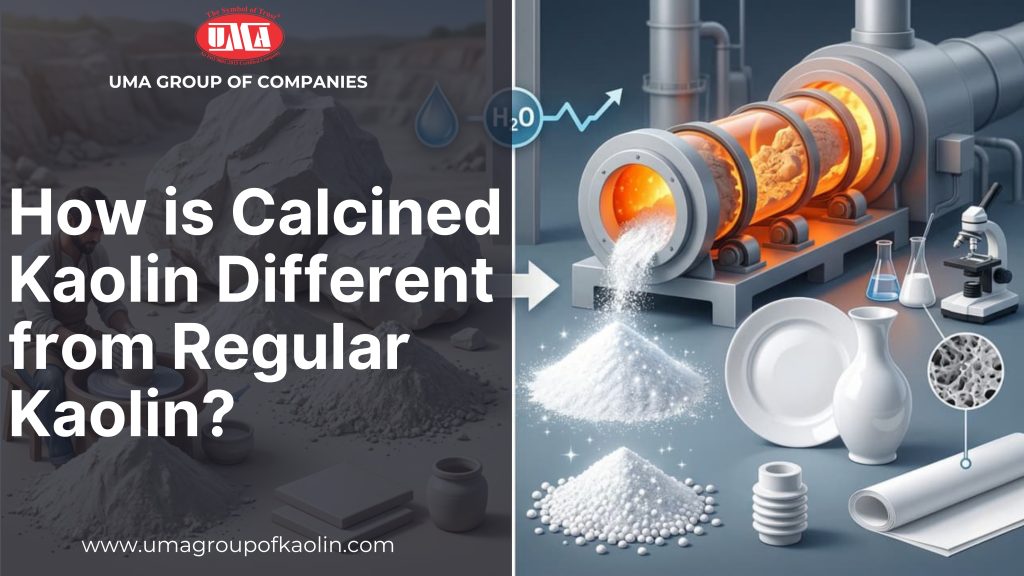
Calcined Kaolin is produced by heating hydrous kaolin at high temperatures (above 1000°C), a process known as calcination.
👉 This process removes chemically bound water and changes the mineral structure, resulting in enhanced properties.
🔥 Key Features:
- High brightness and whiteness
- Low moisture content
- Improved hardness
- Better opacity
- Enhanced insulation properties
👉 Used in:
- Paints and coatings
- Plastics and polymers
- High-performance ceramics
- Refractory applications
Key Differences Between Calcined Kaolin and Regular Kaolin
| Feature | Calcined Kaolin | Regular (Hydrous) Kaolin |
|---|---|---|
| Processing | Heat-treated (calcination) | Natural form |
| Moisture Content | Very low | Contains bound water |
| Structure | Altered (amorphous) | Natural crystalline |
| Brightness | Higher | Moderate |
| Hardness | Higher | Softer |
| Plasticity | Low | High |
| Applications | Paints, plastics, refractories | Ceramics, paper, rubber |
👉 Calcined kaolin is more suitable for high-performance industrial applications, while hydrous kaolin is ideal for traditional uses.
Industrial Applications Comparison
🎨 Paint & Coatings Industry
- Calcined kaolin → Better opacity and brightness
- Hydrous kaolin → Used as filler
🏺 Ceramics Industry
- Hydrous kaolin → High plasticity for shaping
- Calcined kaolin → Used in specialized ceramics
🧴 Plastics & Rubber Industry
- Calcined kaolin → Improves strength and rigidity
- Hydrous kaolin → Used as general filler
Advantages of Calcined Kaolin
- Higher brightness and opacity
- Better thermal stability
- Improved electrical insulation
- Low moisture content
- Enhanced durability
Advantages of Hydrous Kaolin
- Excellent plasticity
- Cost-effective
- Natural and versatile
- Ideal for shaping and molding
How to Choose the Right Type?
👉 Choose Calcined Kaolin if you need:
- High performance
- Better opacity
- Heat resistance
👉 Choose Hydrous Kaolin if you need:
- Plasticity
- Easy molding
- Cost-effective solution
Why Choose a Reliable Supplier?
Selecting a trusted kaolin clay manufacturer and exporter in India ensures:
- Consistent quality
- Customized grades
- Advanced processing
- Bulk supply capability
Why UMA Group of Companies?
UMA Group is a leading calcined kaolin and hydrous kaolin supplier in India, offering:
- High purity kaolin products
- Advanced calcination technology
- Customized industrial solutions
- Reliable domestic & global supply
Conclusion
The difference between calcined kaolin and regular kaolin lies in their processing, properties, and applications. While hydrous kaolin is ideal for traditional uses like ceramics and paper, calcined kaolin offers superior performance for advanced industrial applications.
Choosing the right type depends on your specific industry requirements and performance needs.